


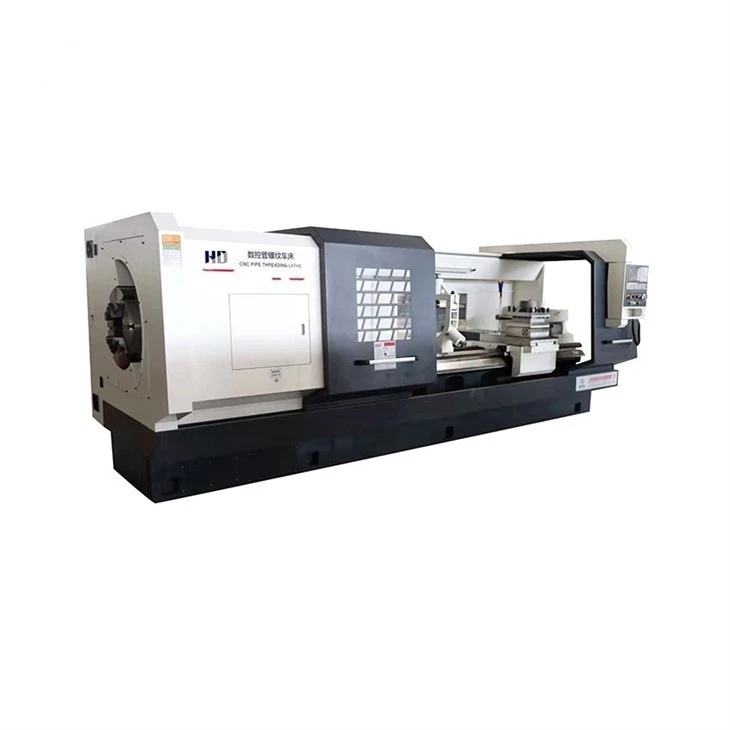
Model QK1313/ QK1319/ QK1322/ QK1325/ QK1327/ QK1330/ QK1335/ QK1343/ QK1353 CNC pipe threading lathe is a high efficiency and high precision continuous control CNC machine tool independently developed by our factory according to the development needs of petroleum industry.
Specification Parameter
|
Specification |
Unit |
QK1313 |
QK1319 |
QK1322 |
QK1325 |
|
|
Max. swing over bed diameter |
mm |
630 |
630 |
670 |
800 |
|
|
Max. swing over cross slide diameter |
mm |
330 |
330 |
370 |
540 |
|
|
Length of workpiece |
mm |
1500/3000 |
||||
|
Width of bed |
mm |
550 |
550 |
550 |
550 |
|
|
Spindle bore |
mm |
135 |
200 |
225 |
255 |
|
|
Power of spindle motor |
kw |
11 |
11 |
11 |
11 |
|
|
Mode of spindle speed |
Two gears, stepless in gears |
|||||
|
Spindle speed range |
r/min |
L: 0-130 |
L: 25-120 |
L: 25-120 |
L: 15-100 |
|
|
H: 130-800 |
H: 100-500 |
H: 100-500 |
H: 100-350 |
|||
|
X/Z axis travel |
mm |
X:350 Z:1250 |
||||
|
X/Z rapid traverse speed |
mm/min |
4000 |
4000 |
|||
|
X axis motor |
Speed |
r/min |
1500 |
1500 |
1500 |
1500 |
|
Torque |
N.m |
10 |
10 |
10 |
10 |
|
|
Power |
kw |
1.5 |
1.5 |
1.5 |
1.5 |
|
|
Z axis motor |
Speed |
r/min |
1500 |
1500 |
1500 |
1500 |
|
Torque |
N.m |
15 |
15 |
15 |
15 |
|
|
Power |
kw |
2.3 |
2.3 |
2.3 |
3.8 |
|
|
Tailstock quill |
Diameter |
mm |
100 |
|||
|
Travel |
mm |
250 |
||||
|
Taper |
Morse 5 |
|||||
|
Turret |
Type |
Vertical four station |
||||
|
Chuck |
K11-380 3 jaw chuck |
K11-500 3 jaw chuck |
K72-630 4 jaw chuck |
|||
|
CNC control system |
GSK, FANUC, SIEMENS |
|||||
|
Positioning accuracy |
mm |
0.02 |
||||
|
Repeatability |
mm |
0.01 |
||||
|
Overall dimension |
mm |
3700*1755*1800 |
3700*1755*1800 |
3700*1755*1800 |
3700*2000*1800 |
|
|
Net weight |
T |
4 |
4.6 |
5.2 |
6 |
|
|
Specification |
Unit |
QK1327 |
QK1330 |
QK1335 |
QK1343 |
QK1353 |
|
|
Max. swing over bed diameter |
mm |
800 |
800 |
1000 |
1000 |
1250 |
|
|
Max. swing over cross slide diameter |
mm |
480 |
480 |
610 |
610 |
860 |
|
|
Max. length of workpiece |
mm |
1500/3000 |
|||||
|
Width of bed |
mm |
600 |
600 |
755 |
755 |
||
|
Spindle bore |
mm |
280 |
305 |
360 |
440 |
540 |
|
|
Power of spindle motor |
kw |
15 |
15 |
22 |
22 |
||
|
Mode of spindle speed |
Two gears, stepless in gears |
||||||
|
Spindle speed range |
r/min |
L: 20-100 |
L: 20-100 |
L: 30-130 |
L: 23-120 |
L: 23-120 |
|
|
H: 100-300 |
H: 100-300 |
H: 65-260 |
H: 65-258 |
H: 65-258 |
|||
|
X/Z axis travel |
mm |
X:450 Z:1250 |
X:450 Z:1250 |
X:550 Z:1250 |
X:570 Z:1250 |
||
|
X/Z rapid traverse speed |
mm/min |
4000 |
4000 |
1400 |
2000 |
||
|
X axis motor |
Speed |
r/min |
1500 |
1500 |
1500 |
2000 |
|
|
Torque |
N.m |
15/18 |
15/18 |
18 |
22 |
||
|
Power |
kw |
2.8 |
2.8 |
2.8 |
2.8 |
||
|
Z axis motor |
Speed |
r/min |
1500 |
1500 |
1500 |
2000 |
|
|
Torque |
N.m |
18/22 |
18/22 |
22 |
30 |
||
|
Power |
kw |
3.8 |
3.8 |
3.5 |
3.5 |
||
|
Tailstock quill |
Diameter |
mm |
100 |
100 |
140 |
160 |
|
|
Travel |
mm |
250 |
250 |
300 |
300 |
||
|
Taper |
Morse 6 |
Morse 6 |
Morse 6 |
Morse 6 |
|||
|
Turret |
Type |
Vertical four station |
|||||
|
Chuck |
K72-630 4 jaw chuck |
K72-630 4 jaw chuck |
780 4 jaw chuck |
1000 4 jaw chuck |
4 jaw chuck |
||
|
CNC control system |
GSK, FANUC, SIEMENS |
||||||
|
Positioning accuracy |
mm |
0.02 |
0.02 |
0.02 |
0.02 |
0.04 |
|
|
Repeatability |
mm |
0.01 |
0.01 |
0.01 |
0.01 |
0.02 |
|
|
Overall dimension |
mm |
4000*2100* 2100 |
4000*2100* 2100 |
5000*2200* 2100 |
5000*2200*2100 |
5000*2800* 2200 |
|
|
Net weight |
T |
7 |
7.5 |
12 |
14 |
18 |
|
Product Feature
Feed system, the bed saddle of CNC pipe threading lathe machine along the bed in the direction of the Z axis movement is driven by the Z axis servo motor through the coupling directly driven ball screw; The tool rest of CNC pipe threading lathe machine on the saddle moves in the direction of the X axis, which is driven by the ball screw drive driven by the X axis servo motor through the direct connection of the coupling. The spindle of machine tool should be designed with high precision and high rigidity. Guide form: horizontal bed, mountain - plane combination guide form.
Lubrication of the headbox is provided by the oil pump system in the box. The saddle and slide plate of CNC pipe threading lathe machine are lubricated by the lubrication system.
Bed of CNC pipe threading lathe machine with high rigidity for the sturdy body and widened guide-ways ,and with long life and high precision retentiveness for the twice aging, hardening,and grinding. Headstock strong enough to support the heavy cutting and finish turning for the sturdy structure ,quenched and ground gears, large spindle, and precision heavy-duty bearings. Centralized auto lubrication.Guide-ways with TSF coated
make the friction reduced and the servo performance promoted. Chuck arrangement both at front end and rear end secures the stability and reliability.
The CNC pipe Thread Lathes,Specially Produced for pipe Thread turning is availabie for the metric and inch cylindcal pipe Thread turning and
cone-shaped pipe Thread turning It is also available for the common lathe turning,boring,interior and exterior conical surface turning, and facing.
The application of this kind of lathe covers metallurgy,chemical industry, hydroel-ectric industry,and geologic industry for the process of drill pipe,
drill collar,Kelly bar and ferrule, and it is suitable for the process of the oil pipe and steel pipe most.
Pipe thread lathe, also known as pipe thread lathe, is a horizontal lathe designed specifically for turning large-diameter pipe fittings. It is characterized by a relatively large spindle through-hole diameter (generally above 135mm) and chucks at the front and rear of the spindle box for easy clamping and processing of large-diameter pipe fittings or rods. This product is widely used in mechanical processing operations in industries such as machinery manufacturing, petroleum, chemical, coal, geological exploration, and urban water supply and drainage.
Pipe thread lathes are mainly divided into two types based on their control and operation methods: ordinary pipe thread lathes and CNC pipe thread lathes
Pipe thread lathes generally have a large through-hole on the spindle box, and the workpiece passes through the through-hole and is clamped by two chucks located at both ends of the spindle for rotary motion. There are generally two ways to feed the cutting tool: one is to drive the slide plate and tool holder located in front of the bed by the screw, which is the same as that of a regular lathe; Another method is to use a flat comb blade with an external thread cutting head located on the slide plate in the center of the bed to cut into the workpiece and move forward accordingly. Some machine tools for processing long pipes also come with workpiece support devices, such as center frames, follower frames, rear supports, etc.
Standard Configuration
1) Domestic wafangdian bearing
2) Brand-name centralized lubricating system
3) Domestic brand-name electric tool post
4) Domestic brand-name ball-screw
Optional Configuration
1) V6 turret, V8 turret
2) power chuck :(QK1313/QK1319/QK1322)
3) Electric chuck(QK1327/QK1335/QK1343) (with limited chucking range)
4) Back support center post,Steady rest
5) Chip removal machine
Packaging


Production Device


Customer


Pipe thread lathe Operation And Classification
1.Operation process of thread lathe
1. Inspection before driving
1.1 Add appropriate lubricating grease according to the lubrication chart of the machine tool.
1.2 Check all electrical facilities, including handles, transmission parts, protection, and limit devices, for completeness, reliability, and flexibility.
1.3 Each gear should be at zero position, and the belt tension should meet the requirements.
1.4 It is not allowed to directly store metal objects on the bed surface to avoid damaging the bed surface.
1.5 Workpiece to be processed, free of mud and sand, to prevent mud and sand from falling into the trailer and damaging the guide rail.
1.6 Before clamping the workpiece, an empty test run must be conducted to confirm everything is normal before installing the workpiece.
2. Operating procedures
2.1 After loading the workpiece, start the lubricating oil pump first to ensure that the oil pressure meets the requirements of the machine tool before starting.
2.2 When adjusting the exchange gear frame and the hanging wheel, the power must be cut off. After adjustment, all bolts must be tightened, the wrench should be removed in a timely manner, and the workpiece should be disconnected for trial operation.
2.3 After loading and unloading the workpiece, the chuck wrench and floating object of the workpiece should be immediately removed.
2.4 Adjust the tailstock, rocker, etc. of the machine tool to the appropriate position according to the processing needs, and tighten or clamp them.
2.5 Workpieces, cutting tools, and fixtures must be securely clamped. The floating force tool must insert the lead part into the workpiece before starting the machine tool.
2.6 When using the center frame or follower frame, the center must be adjusted properly and there must be good lubrication and support contact surfaces.
2.7 When processing long materials, the protruding part behind the spindle should not be too long. If it is too long, a material rack should be installed and a danger sign should be hung.
2.8 When entering the knife, the knife should slowly approach the work to avoid collision; The speed of the trailer back and forth should be uniform. When changing the tool, it is necessary to maintain an appropriate distance between the tool and the workpiece.
2.9 The cutting tool must be securely fastened, and the extended length of the tool should generally not exceed 2.5 times the thickness of the tool.
2.10When processing eccentric parts, appropriate counterweights must be used to balance the center of gravity of the chuck, and the vehicle speed must be appropriate.
2.11 Protective measures must be taken for workpieces with disk cards that exceed the body of the machine.
2.12 The adjustment of the tool must be slow. When the blade is 40-60 millimeters away from the workpiece processing area, manual or working feed should be used instead of rapid feed and direct cutting.
2.13 When using a file to polish the workpiece, the tool holder should be moved back to a safe position, and the operator should face the chuck with their right hand in front and their left hand behind. Workpieces with keyways and square holes on the surface are prohibited from being processed with a file.
2.14 When using sandpaper to polish the outer circle of the workpiece, the operator should follow the posture specified in the previous section and hold both ends of the sandpaper with both hands to polish it. Do not use fingers to grip sandpaper and polish the inner hole.
2.15 When automatic cutting, the small knife holder should be adjusted to be level with the base to prevent the base from touching the chuck.
2.16 When cutting large or heavy parts or materials, sufficient machining allowance should be left.
3. Parking operation
3.1 Cut off the power and remove the workpiece.
3.2 Knock down the zero position of each handle, count the tools and equipment, and clean them.
3.3 Check the condition of each protective device.
4. Precautions during operation
4.1 Non staff members are strictly prohibited from operating the machine tool.
4.2 It is strictly prohibited to touch cutting tools, rotating parts of machine tools, or rotating workpieces during operation.
4.3 Emergency stop is not allowed. In case of emergency, after using this button to stop the machine, it should be rechecked according to the pre start regulations of the machine tool.
4.4 It is not allowed to pedal the guide surface, screw, and light rod of the lathe. Unless otherwise specified, it is not allowed to use feet instead of hands to operate the handle.
4.5 Parts with sand holes, shrinkage holes, or keyway on the inner wall are not allowed to be scraped with triangular scraping.
4.6 The compressed air or liquid pressure of the pneumatic hydraulic chuck must reach the specified value before it can be used.
When turning slender workpieces with a length exceeding 4 times the diameter on both sides of the head of the bed, the tip should be used according to the process regulations. Center frame or follow-up frame support. When extending behind the head of the bed, protective devices and warning signs should be added.
When cutting brittle metals or cutting materials that are prone to splashing (including grinding), protective barriers should be added, and operators should wear protective goggles.
5.Classification
1)Short thread lathe
The layout of the short thread lathe is basically similar to that of a regular lathe. The thread formation motion between the workpiece and the tool is not achieved using a screw, but by a cam installed in the middle of the bed. The lift profile of the cam drives the tool holder forward and turns threads; The descent profile causes the tool holder to return. It can avoid frequent forward and reverse rotation of the spindle and lead screw during high-speed thread turning on general lathes.
2)Pipe thread lathe
The pipe threading lathe generally has a large through-hole on the spindle box, and the workpiece passes through the through-hole and is clamped by two chucks located at both ends of the spindle for rotary motion. There are generally two ways to feed cutting tools: one is similar to a regular lathe, which is driven by a screw to move the slide and tool holder in front of the bed; Another method is to use a flat comb blade external thread cutting head located on the slide plate in the center of the bed to cut into the workpiece and move forward accordingly. Some machine tools for processing long pipes also come with workpiece support devices. The pipe threading lathe has partially adopted digital control. For every 1 revolution of the workpiece, the tool moves uniformly according to the number of feed pulses by a distance equivalent to the selected pitch, which is very convenient for machining taper threads, changing pitch, and correcting pitch errors. This type of machine tool can process workpieces up to 15 meters in length and up to 400 millimeters in diameter.
3)Oil pipe joint thread lathe
The oil pipe joint thread lathe can also be digitally controlled. Due to the different rotation directions of the internal taper threads at both ends of the pipe joint and the high requirement for concentricity, some machine tools can use hydraulic methods to turn the workpiece clamp after machining one end of the thread, in order to turn the thread on the other end.
4)Screw lathe
The difference between a screw lathe and a regular lathe is that the diameter of the mother screw is larger and placed between the two guide rails of the bed, rather than in front of the bed. In order to improve machining accuracy, the machine tool is equipped with a pitch error correction device, mainly used for turning precision lead screws. The pitch error of the workpiece generally does not exceed 7 microns per 300 millimeters.
Hot Tags: pipe threading lathe machine, China pipe threading lathe machine manufacturers, suppliers, factory, fixed milling machine, milling machine, double column vertical lathe, lead vertical lathe, hydraulic milling machine, milling vertical lathe


