

CNC Lathe
-
![CNC Horizontal Lathe]() CNC Horizontal LatheModel CK6140/ CK6150/ CK6160/ CK6163/ CK6180/ CK61100/ CK61125 flat bed CNC lathe is made of high-strength cast iron, added with special materials of copper and chromium, which effectively...read more
CNC Horizontal LatheModel CK6140/ CK6150/ CK6160/ CK6163/ CK6180/ CK61100/ CK61125 flat bed CNC lathe is made of high-strength cast iron, added with special materials of copper and chromium, which effectively...read more -
![TCK Series Inclined Bed Cnc Lathe]() TCK Series Inclined Bed Cnc LatheThe TCK6340 slant bed lathe excels in precision machining of shaft and disk parts. Capable of turning diverse screw threads, arcs, cones, and internal/external planes, it handles ferrous and non -...read more
TCK Series Inclined Bed Cnc LatheThe TCK6340 slant bed lathe excels in precision machining of shaft and disk parts. Capable of turning diverse screw threads, arcs, cones, and internal/external planes, it handles ferrous and non -...read more -
![TCK6340 Slant Bed CNC Lathe]() TCK6340 Slant Bed CNC LatheThe TCK6340 slant bed lathe excels in precision machining of shaft and disk parts. Capable of turning diverse screw threads, arcs, cones, and internal/external planes, it handles ferrous and non -...read more
TCK6340 Slant Bed CNC LatheThe TCK6340 slant bed lathe excels in precision machining of shaft and disk parts. Capable of turning diverse screw threads, arcs, cones, and internal/external planes, it handles ferrous and non -...read more -
![CNC Flat Bed Lathe]() CNC Flat Bed LatheModel CK6140/ CK6150/ CK6160/ CK6163/ CK6180/ CK61100/ CK61125 flat bed CNC lathe is made of high-strength cast iron, added with special materials of copper and chromium, which effectively...read more
CNC Flat Bed LatheModel CK6140/ CK6150/ CK6160/ CK6163/ CK6180/ CK61100/ CK61125 flat bed CNC lathe is made of high-strength cast iron, added with special materials of copper and chromium, which effectively...read more -
![CNC Horizontal Lathe Machine]() CNC Horizontal Lathe MachineModel CK6140/ CK6150/ CK6160/ CK6163/ CK6180/ CK61100/ CK61125 flat bed CNC lathe is made of high-strength cast iron, added with special materials of copper and chromium, which effectively...read more
CNC Horizontal Lathe MachineModel CK6140/ CK6150/ CK6160/ CK6163/ CK6180/ CK61100/ CK61125 flat bed CNC lathe is made of high-strength cast iron, added with special materials of copper and chromium, which effectively...read more -
![Horizontal CNC Lathe]() Horizontal CNC LatheModel CK6140/ CK6150/ CK6160/ CK6163/ CK6180/ CK61100/ CK61125 flat bed CNC lathe is made of high-strength cast iron, added with special materials of copper and chromium, which effectively...read more
Horizontal CNC LatheModel CK6140/ CK6150/ CK6160/ CK6163/ CK6180/ CK61100/ CK61125 flat bed CNC lathe is made of high-strength cast iron, added with special materials of copper and chromium, which effectively...read more -
![Flat Bed CNC Lathe Machine]() Flat Bed CNC Lathe MachineModel CK6140/ CK6150/ CK6160/ CK6163/ CK6180/ CK61100/ CK61125 flat bed CNC lathe is made of high-strength cast iron, added with special materials of copper and chromium, which effectively...read more
Flat Bed CNC Lathe MachineModel CK6140/ CK6150/ CK6160/ CK6163/ CK6180/ CK61100/ CK61125 flat bed CNC lathe is made of high-strength cast iron, added with special materials of copper and chromium, which effectively...read more -
![Flat Bed Lathe Machine]() Flat Bed Lathe MachineModel CK6140/ CK6150/ CK6160/ CK6163/ CK6180/ CK61100/ CK61125 flat bed CNC lathe is made of high-strength cast iron, added with special materials of copper and chromium, which effectively...read more
Flat Bed Lathe MachineModel CK6140/ CK6150/ CK6160/ CK6163/ CK6180/ CK61100/ CK61125 flat bed CNC lathe is made of high-strength cast iron, added with special materials of copper and chromium, which effectively...read more -
![Slant Bed Lathe CNC]() Slant Bed Lathe CNCModel SAH4030/ SAH4042/ SAH4050/ TK350/ TK500/ TK1000 slant bed lathe cnc is suitable for machining of shaft and disc type parts.read more
Slant Bed Lathe CNCModel SAH4030/ SAH4042/ SAH4050/ TK350/ TK500/ TK1000 slant bed lathe cnc is suitable for machining of shaft and disc type parts.read more
The machine is beautiful in appearance, reasonable in... -
![CNC Slant Bed Lathe]() CNC Slant Bed LatheModel SAH4030/ SAH4042/ SAH4050/ TK350/ TK500/ TK1000 slant bed cnc lathe is suitable for machining of shaft and disc type parts.read more
CNC Slant Bed LatheModel SAH4030/ SAH4042/ SAH4050/ TK350/ TK500/ TK1000 slant bed cnc lathe is suitable for machining of shaft and disc type parts.read more
The machine is beautiful in appearance, reasonable in... -
![Inclined Bed Lathe]() Inclined Bed LatheModel SAH4030/ SAH4042/ SAH4050/ TK350/ TK500/ TK1000 slant bed cnc lathe is suitable for machining of shaft and disc type parts.read more
Inclined Bed LatheModel SAH4030/ SAH4042/ SAH4050/ TK350/ TK500/ TK1000 slant bed cnc lathe is suitable for machining of shaft and disc type parts.read more
Machines with pleasing appearance, reasonable structure... -
![Pipe Threading Lathe]() Pipe Threading LatheModel QK1313/ QK1319/ QK1322/ QK1325/ QK1327/ QK1330/ QK1335/ QK1343/ QK1353 CNC pipe threading lathe is a high efficiency and high precision continuous control CNC machine tool independently...read more
Pipe Threading LatheModel QK1313/ QK1319/ QK1322/ QK1325/ QK1327/ QK1330/ QK1335/ QK1343/ QK1353 CNC pipe threading lathe is a high efficiency and high precision continuous control CNC machine tool independently...read more


Our Factory

Dalian Haidi Machinery Co.,Ltd is a professional manufacturer that specializes in the development, research and production of single-column vertical lathe, double-column vertical lathe, horizontal lathe, boring-milling machine, machining center, gear hobbing machine. The researched products by our company have such advantages as a great variety, complete specification, advanced technology and outstanding quality. Haidi Machinery covers building area of 30,000 square meters. Now we have more than 200 staff members, including 11 senior engineers, 8 senior managerial staff, over 160 technical workers. Our factory has strong strength and excellent processing equipment. The machine tools produced by our factory are sold all over the country and the world. The advanced design, reliable trustworthy, simple operation, flexible use, high precision, high cost performance and perfect after-sales service have won the unanimous praise of users. Our company is the largest enterprise that specializes in the casting of machine tool in southern Liaoning.In the meantime, it has offered great support to speed up our company's product research and production and made great contribution to providing products to customers in the shortest duration.


What Is CNC Lathe
A CNC lathe is a machine that spins material around a central spindle and a fixed cutting tool. Instead of being controlled by physical labor, the movement of your components is determined by coded instructions fed to a computer. Multiple stages may be set simultaneously, avoiding the need for your component to leave the lathe between producing and ensuring accurate cut placement. The CNC lathe idea has been improved to meet current industrial demands, such as automation. Lathes may now attain incredible precision with computer numerical control(CNC) machining.
Advantages of CNC Lathe
No need for highly skilled operators
In the past, working with lathes required two highly skilled operators, one handling the lathe and the other controlling the material. It was a tough job.
Full automation
Producing hundreds, even millions, of similar dimensions is easier than ever, thanks to modern CNC lathes. Machine-controlled systems enable CNC lathes to produce perfect pieces easier and quicker than ever before.
Highly versatile
Unlike manual lathes, CNC lathes are versatile enough to produce nearly any kind of product or part from sturdy furniture pieces and car parts to delicate lamps and crockery.
High accuracy
As less manual labor is involved, the chances of achieving optimal accuracy are pretty high with CNC lathes.
Why Choose Us
Experienced team
Our staff comprises seasoned professionals with extensive experience in technology development, offering deep expertise in a wide array of tech domains.
Quality assurance
We adhere to stringent quality control processes to deliver reliable and high-performance products that exceed industry standards.
Customization
Our team of experts provides tailored services to address specific challenges, ensuring each solution is unique and perfectly suited to the client's requirements.
After-sales service
Dedicated to strict quality control and thoughtful customer service, our experienced staff members are always available to discuss your requirements and ensure full customer satisfaction.
Leading factory
20+years' production experience as the leading manufacturer for vertical lathe,horizontal lathe, machining center,boring machine,milling Machine, drilling machine, slotting machine, gear hobbing machine, etc.
Exportation to 60+ countries
Our products have exported to Australia, Chile, Peru, Turkey, Russia, Indonesia, Saudi Arabia,USA, Belarus, Argentina Singapore and others, around 60 countries.
Introduction To The Main Components Of CNC Lathe


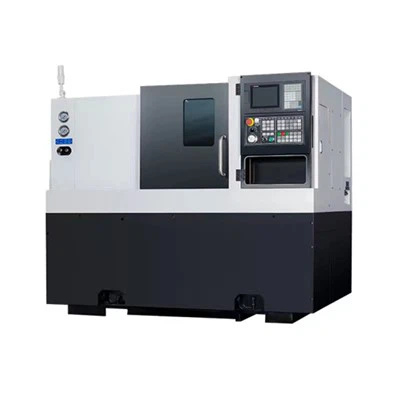

Lathe machines are generally designated with a swing which is the largest working diameter that swings the lathe bed. A Lathe swing is used to rotate objects that can do cutting, sanding and drilling. Some other specifications of lathe machines are the length of its bed. Distances between the headstock and tailstock center. Headstock, which is an important component of CNC Machine that drives the motor and powers the spindle. The front component of a CNC turning machine is made up of the headstock. The drive motor powers this spindle. The spindle is attached to the chuck or collet. During the turning process, one of them grips the workpiece. The jaws of the chuck grasp the machined component. It connects directly to the spindle but is removable, allowing for machining various sized pieces. A chuck is a tiny version of a collet. Collets may be used on parts up to 60 mm in diameter.
For small parts, they give a more excellent grip. The jaws of the chuck grasp the machined component. It connects directly to the spindle but is removable, allowing for machining various sized pieces. A chuck is a tiny version of a collet. Collets may be used on parts up to 60 mm in diameter. For small parts, they give a more excellent grip. A CNC turning center’ s opposite end is the tailstock. The aim of a tailstock attached directly to the bed is to provide support for longer workpieces. Hydraulic force is used to support the tailstock quill. The spindle continues to be the driving force and the tailstock follows the component.
A tailstock is not suitable when face turning is required because the tailstock will get in the way. The bed is just a foundation plate that rests on the table and supports other machine components. The carriage is heat-treated to survive the machining impacts that runs over the bed. The carriage is supported by means that let the rotating workpiece slide. It holds the tools in position, enabling the cutting operation to continue.
The simplest of the lathe turning machine is the 2 axis machine that spins on two axis in a fixed position called the station turret. This spinning action part is called turning. There are other CNC lathe machines like the 3-Axis, 4-Axis & 5-Axis milling machines. These machines have at least a 3 axis and move and operate on the X as Vertical, Y as horizontal and Z axis as depth. There are additional A and B axis for machines like the 4 Axis and 5 Axis Machines. 9-axis CNC is a blend of lathe and 5-axis machining. With 9 functional axes, the part can be turned and multi-axis milled in a singular set-up.
Operation and Process of CNC Lathe
A basic CNC lathe rotates the material it cuts while operating on two axes. Because the rotation of the material is usually referred to as turning, CNC lathes are sometimes referred to as CNC lathes. The inside and outside of the component may be machined using CNC lathes. Internal operations will act to change the workpiece’ s inner diameter. External processes shape the exterior.
A Lathe CNC machine is basically a shaping device used primarily for shaping of hard materials like metal and wood. The rotating device in the machine functions as a stationary cutting tool. With the help of CNC computers and programming these machines have a higher accuracy of cutting tools that were used before the advancement of these technologies. The Industrial Applications of Lathe Machines are cutting, drilling, sanding, turning or shaping of any kind. These machines are used in Factories and machine shops and have a versatility of cnc programming and softwares and does not just rely on the hands of factory workers.
Investing in a computer numerical control lathe versus a manual lathe has various advantages. Because their movement is controlled by code, computer-operated lathes are very exact. Multiple CNC lathes may be operated concurrently by a single operator but manual lathes demand more attention. While CNC lathes are initially more expensive, they can be less expensive to operate in terms of less staffing. Manufacturing times are shorter since more CNC machines are running simultaneously and all products produced are practically identical thanks to the accuracy of computer numerical control. Also Read: CNC Machine Installation
Introduction To The Basic Knowledge Of CNC Lathe
A lathe is traditionally used in woodturning, metalworking, metal spinning, thermal spraying, parts reclamation, and glass-working. One or two centers typically hold the workpiece, and at least one center can be moved horizontally to accommodate workpieces of different lengths. CNC lathes are quickly replacing older production lathes due to their ease of setting, operation, repeatability, and accuracy. CNC lathe work is just one type of CNC machining.
First, CNC stands for computer numerical control and refers to a machine operated by a computer system. A CNC lathe is operated with precise design instructions to machine parts to precise specifications. A CNC lathe is a machine tool where the material or part is held in place and rotated by the main spindle as the cutting tool that works on the material is mounted and moved on various axes.
A simple CNC lathe operates on two axes with the cutting tool in a fixed position at 8 to 24 station turret. The rotating action of the workpiece is called turning. This is why certain types of CNC lathes are called CNC Turning Machines. CNC lathes produce precise round shapes with an outer diameter (OD) and an inner diameter (ID). Many different kinds of structures can be machined with this machine tool, depending on their various industries’ needs. They are commonly used in oil and gas, automotive, aerospace, medical, electronics, mining, power plant, steel and paper mills, and shipbuilding industries.
Modern CNC lathe machines usually come with tools that could work on multiple axes. Different types of machines can include both X and Y-axis, incorporate a second turret with other tools, or include a second spindle. This means a CNC lathe can perform additional milling, drilling, and tapping operations, resulting in a complete and even complex part manufacturing process and eliminating the need to transfer the part to another machine for a second operation.
Types Of CNC Lathes
CNC lathes are classified into types by how many axes they have. They are available with different axes, allowing more complex parts to be produced without manually switching machines or tools. The different axes affect how the machined part or the tool can be positioned, rotated, and approached during the machining process. 2-Axis CNC Lathe has two linear axes that can perform outer diameter/inner diameter, basically cylindrical machining, and facing operations, or drilling and tapping at the center of the part. It has an X and Z axis and does not allow for milling.
With a 3-axis CNC lathe, a C axis and life tool system are added, allowing the part to be positioned so that standard milling operations, boring, and tapping operations can be performed. Helical milling operations that require the slow sync rotation of the workpiece are possible.
A 4-axis machine has an added Y-axis so that off-center machining operations can be performed. The fourth axis works well for more irregular and complex lathework.
In 5-axis lathes, a second turret is added to a 3-axis CNC lathe. Such machines would then have two axes at each upper and lower turret plus the C-axis on the rotating spindle. This enables the use of two tools at the same time on the part, which drastically increases machining speed. With more than five axes, the permutation may include the following: two C-axes with a primary and second spindle; two turrets, with an upper and lower turret, each with two linear axes; one Y-axis at the upper turret; and a second spindle that can move towards the main spindle to pick up the part. There are even machines with more than eight axes. However, 8-axis lathes are highly sophisticated and complex machines that aren't generally needed for everyday manufacturing needs.
CNC Lathe Applications and Precautions
The material being worked by a CNC lathe machine is slowly sheared away. The result is a precisely finished product or an intricate part. Because these machines are so versatile, many industries use them, including automotive, electronics, aerospace, firearm manufacturing, sporting, and others. A CNC lathe can produce plane surfaces and screw threads or, in the case of ornate lathes, three-dimensional products that are quite complex. They can be used on both small and large parts with extreme accuracy.
The workpiece is typically held firmly in place by one or two centers, but the material can also be secured with collets or clamps. Some examples of items a CNC lathe machine can make include baseball bats, camshafts, bowls, crankshafts, cue sticks, sign boards, musical instruments, and table and chair legs. A CNC lathe must be used with care. Although the process is automated, an operator must understand computer programming parameters, safety standards, and other vital information.
With the lathe’ s focus on detail, a qualified professional must run the machine. Manufacturing processes are made easier due to the automation, which consists of complex commands and speed rate instructed by an internal computer, but a human operator must still oversee the overall process. This means that special training to develop the necessary skills is essential. When choosing the right CNC lathe machine, there are many factors to consider, such as the quality of clamps that hold the workpiece steady and the CNC lathe machine’ s tolerance level. Weight is a significant factor in choosing a CNC machine.
A heaver machine will survive the rigorous vibrations and other operations that impact a CNC lathe' s effectiveness. A lightweight CNC lathe can get out of balance more quickly, thus impacting the output result. The swing measurement is another consideration. It is the maximum amount of diameter of any material which can be cut or machined on a lathe. This measurement is taken from the bed of the lathe to the center of the spindle. If the desired output size is known, this measurement will help when choosing a CNC lathe.
How Does a CNC Lathe Machine Work?
Delving into the workings of a CNC lathe unveils a symphony of precision engineering and computerized control. Unlike a manual lathe, where the craftsmanship lies primarily in the hands of the operator, a CNC lathe integrates computerized technology to enhance precision and efficiency. Initially, you, the operator, create a detailed design using CAD (Computer-Aided Design) software. This design includes all specifications for the desired part, from dimensions to shapes. The CAD design is then translated into G-code, the programming language that CNC machines understand. This code instructs the CNC lathe on how to move, shape, and create the part. Next, you set up the CNC lathe. This involves selecting and installing the appropriate cutting tools and securing the workpiece onto the machine.
The CNC lathe, guided by the G-code, begins the machining process. The workpiece is rotated at high speeds while the cutting tool is moved across two or more axes to shape the material. Throughout the process, the CNC lathe monitors the cutting conditions and makes real-time adjustments to ensure precision. The final part is checked against the original specifications for accuracy.

Certificate


FAQ
As one of the leading CNC lathe manufacturers and suppliers in China, we warmly welcome you to buy cheap CNC lathe made in China here from our factory. All our products are with high quality and low price.
semi automatic milling machine, semi automatic drilling machine, turning vertical lathe